
The first heritage project ofHull Creative Skills
& Heritage CIC ↗

Hessle Road & its neighbouring streets / 1940–1945

When the sky burned.
When neighbours mattered.

Hessle Road during the Blitz.

Homes, childhoods and familiar streets changed in a night. The surviving records also hold the smallest acts of care: a hand towards shelter, a place at a relative’s table, a cup of tea for the street.

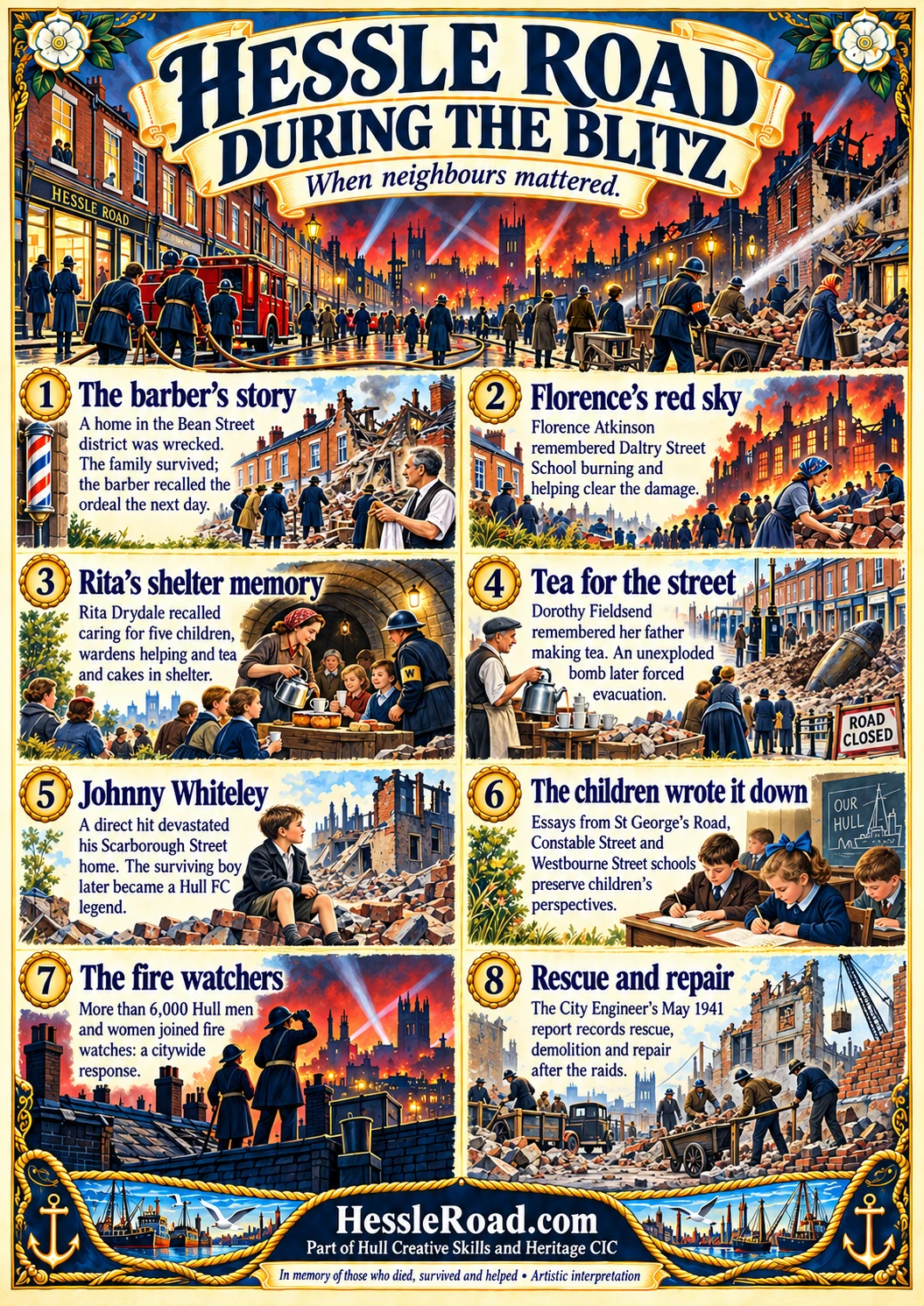
Painted interpretation of Hull’s wartime terraces, civilian wardens helping families and neighbours offering tea
Original artistic interpretation: imagined people and streets, inspired by the civilian experience. Not an archival photograph.

The road within a city at war

A port. A target.
A community.

Hull’s port and proximity to occupied Europe made it vulnerable to attack. Historic England notes that wartime reports often concealed the city’s name behind descriptions such as a northern coastal town.

Source: Historic England: Hull, a northern coastal town ↗

This feature follows the main Hessle Road and its adjoining neighbourhood. Some accounts name a street; others belong to a school collection without identifying a precise address. Hull-wide events and figures are marked separately.

82 raidsHull-wide · June 1940 to March 1945
7–9 May 1941The concentrated attacks remembered as the Hull Blitz
Eight storiesSurvival, childhood memories, rescue and neighbourly care

These dates and raid totals are for Hull, not Hessle Road alone.

Source: Hull History Centre: The Hull Blitz ↗

Keep the dates in view

One May. A much longer war.

Select a date to highlight a moment, or read the full timeline below.

  1. The first raid

    Hull History Centre dates Hull’s first raid to the night of 19/20 June 1940. The first incendiary fell east of the city; this is Hull-wide context, not a Hessle Road incident.

    Source: Hull History Centre: The Hull Blitz ↗
  2. Bean Street district hit

    A contemporary report records a parachute mine in the Bean Street district on the night of 14 March. The barber’s story belongs to this raid, before the great May attacks.

    Source: Ministry of Information: March 1941 report ↗
  3. The great May attacks

    The concentrated attacks over these two nights are the events Hull History Centre identifies as the Hull Blitz of 7, 8 and 9 May.

    Source: Hull History Centre: The Hull Blitz ↗
  4. Children set down their memories

    The Springburn Street School essays record earlier raids through children’s recollections. Their writing dates are not the dates of the events described.

    Source: Hull History Centre: Children’s Recollections, L DEX24 ↗
  5. The last raid on Hull

    Hull History Centre records 82 raids between the first attack and this last one. The May Blitz was one devastating part of a much longer experience.

    Source: Hull History Centre: The Hull Blitz ↗

Small details. Lives remembered.

Beyond the bomb damage.

Eight windows into the wartime experience. Each story has a source you can follow. Children’s recollections are identified as memories, and gaps in the records remain visible.

Bean Street district · 14/15 March 1941

The barber who found words after the blast

A contemporary report records a barber describing the destruction of his home in the Bean Street district. His wife and children survived. He had gone to put the kettle on; moments later, falling masonry and soot changed everything. By the following day he was recounting the ordeal with humour. The investigators admired his resilience, while acknowledging the shock experienced by local residents.

Source: Ministry of Information: March 1941 report ↗
Bean Street, Regent Street & Daltry Street · recollection written in 1942

Florence’s red sky

Florence Atkinson, aged eleven and a half when she wrote, remembered damaged ornaments, helping her mother clean up, and Daltry Street School burning under a red sky. Her account links Bean Street, Regent Street and Walker Street.

Source: Hull History Centre: Children’s Recollections, L DEX24 ↗

Regent Street & Bean Street · recollection written in 1942

Rita and the children she looked after

Twelve-year-old Rita Drydale described caring for five children, wardens helping people reach shelter, and tea and cakes after the Bean Street mine. Her damaged home meant meals at her aunt’s.

Source: Hull History Centre: Children’s Recollections, L DEX24 ↗

Springburn Street School collection · precise street not specified

A cup of tea for the street

Dorothy Fieldsend, eleven, remembered her father making tea for the street during a quiet spell. An unexploded bomb later forced evacuation. Her account also recalls burning railway lines and a sawmill.

Source: Hull History Centre: Children’s Recollections, L DEX24 ↗

Scarborough Street · exact raid date unconfirmed

Before the rugby legend: a boy who survived

Long before the cheers at the Boulevard, Johnny Whiteley lived through the Blitz. Hull FC records that a direct hit devastated his Scarborough Street home and that he survived. His later life connected the fishing docks, rugby and community service. The club’s account gives us the location, but not the precise date of the bomb strike.

Source: Hull FC: Remembering Johnny Whiteley MBE ↗

St George’s Road, Constable Street & Westbourne Street schools

The children wrote it down

The surviving Zuckerman Archive includes essays from schools in the Hessle Road neighbourhood, including St George’s Road, Constable Street Boys and Westbourne Street Girls. Written for a wider study of bombing’s effects, they preserve children’s perspectives. UEA Archives holds more than 2,000 essays across the Hull and Birmingham collections; that figure is not a Hessle Road total.

Source: University of East Anglia Archives: Children’s essays ↗

Hull-wide context · 1940–1945

The people who watched the roofs

Historic England records more than 6,000 Hull men and women joining fire watches. Their work offers a wider context for the wardens, firefighters and neighbours remembered in local accounts. This citywide figure does not identify how many served on Hessle Road.

Source: Historic England: Hull, a northern coastal town ↗

Hull-wide response · May 1941

After the raid came the rescue

Hull History Centre makes available the City Engineer’s report on rescue, demolition and repair following the May 1941 attacks. It documents the huge task of responding to devastation. For street-level research, this report can be read alongside property-damage and warden records; a family memory alone cannot establish which building was hit on which night.

Source: Hull History Centre: The Hull Blitz ↗
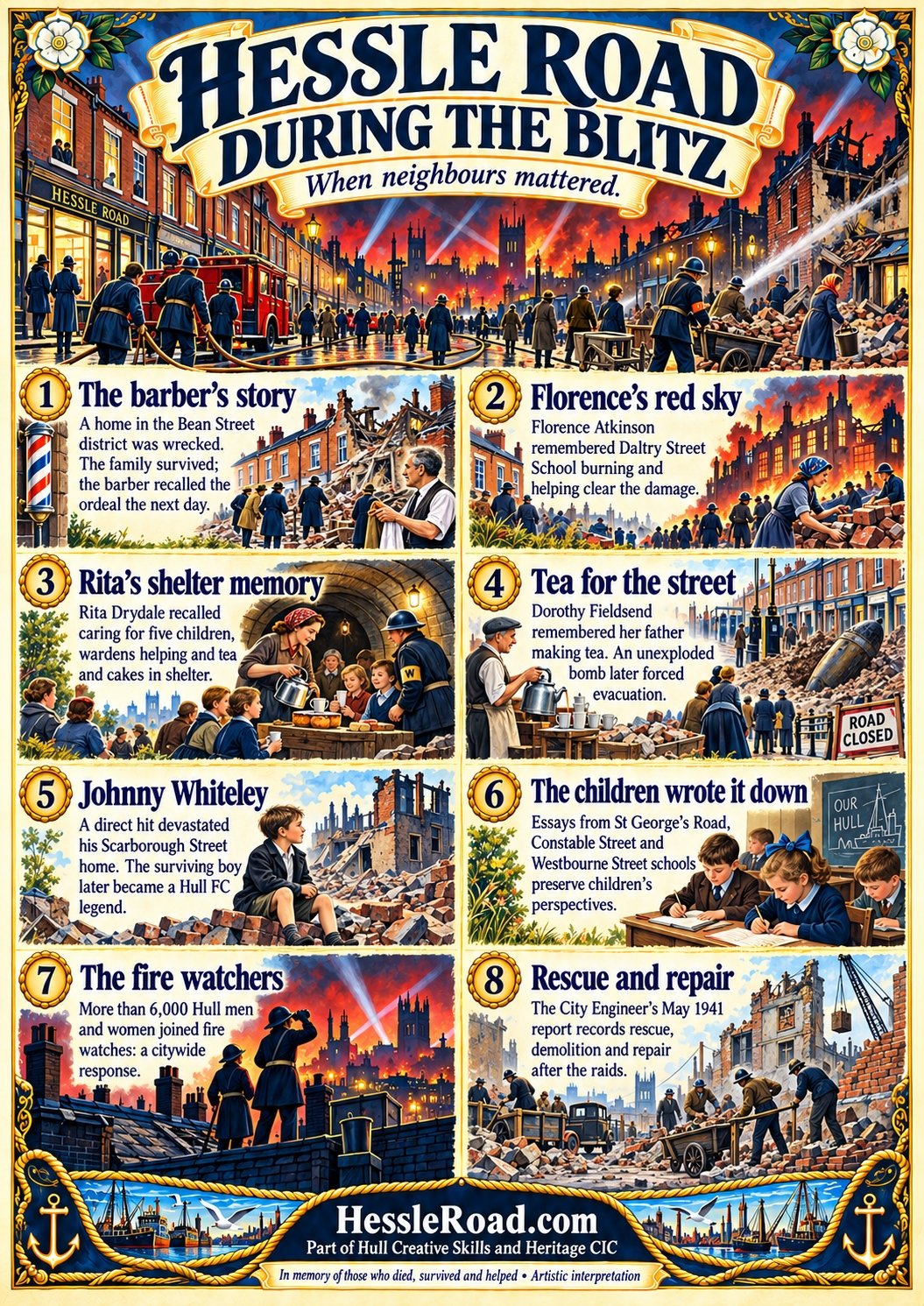
A3 commemorative poster with wartime illustration and eight sourced stories

From our online archive to the Vauxhall Tavern wall

A story worth
keeping in view.

A matching A3 artwork brings the eight stories together in a framed display. The illustration is an artistic interpretation; the names, accounts and dates come from the sources linked here.

297 × 420 mm · portrait · print at actual size. Illustrated scenes are symbolic and do not identify particular victims.

Follow the evidence

The records behind the stories.

Our feature uses concise paraphrases of published records and catalogue descriptions. It does not reproduce the full school essays. Contemporary official reports and later recollections offer different perspectives; neither should be treated as a complete account of every incident.

Ministry of Information: March 1941 report ↗

Contemporary Hull and East Riding Information Committee report; Bean Street and the barber’s account. Official assessments contain period prejudices and are not neutral descriptions of residents.

Does your family remember these streets?

Help us record names, places and stories with care. Tell us whether a memory is first-hand or passed down, and include any photograph dates or document references you know.

Share a wartime memory →

The separate streets and terraces directory remains browse-only: adding details there is coming soon.

Browse the streets & terraces →